| Question |
Answer |
| What is an LWIR camera? |
An LWIR (Long-Wave Infrared) camera operates in the 8–14 µm wavelength band, which is optimal for measuring lower-temperature targets that don't radiate strongly at shorter wavelengths. Unlike single-point pyrometers, the LAND LWIR-640 captures a complete 640 × 480 pixel thermal image—over 307,000 measurement points—allowing you to see temperature distribution across an entire scene. This makes it ideal for monitoring ambient to moderate-temperature processes from -20°C to 1,500°C. |
| LWIR vs MWIR vs SWIR — what's the difference? |
The three infrared bands serve different temperature ranges: SWIR (Short-Wave, ~1.6 µm) is best for very high temperatures like molten metal above 1,500°C; MWIR (Mid-Wave, ~3.9 µm) covers mid-range industrial processes from 300°C to 1,800°C and sees through smoke and combustion gases; LWIR (Long-Wave, 8–14 µm) excels at ambient and lower temperatures from -20°C to around 1,500°C. Selecting the correct waveband ensures accurate readings—using the wrong band can result in significant measurement errors. |
| What is the resolution of the LWIR-640? |
The LWIR-640 features 640 × 480 pixel resolution (307,200 measurement points), providing detailed thermal imaging across the entire field of view. It operates at 60 frames per second for real-time monitoring and offers a ±1°C or ±1% accuracy specification. The high resolution combined with LAND's advanced ImagePro software enables precise analysis of temperature uniformity, hot spot detection and process trending. |
| Can it stream over Ethernet? |
Yes—the LWIR-640 streams over Gigabit Ethernet (GigE) with Power over Ethernet (PoE) support, simplifying installation to a single cable for both power and data. It integrates directly with LAND's ImagePro software and standard SCADA/DCS systems via Modbus TCP or OPC interfaces. The IP66/NEMA 4 rating ensures reliable operation in industrial environments, while the integrated webserver allows browser-based configuration and monitoring. |
| What is its temperature range? |
The LWIR-640 measures from -20°C to 1,500°C using multiple selectable sub-ranges that can be optimized for your specific application temperature window. Standard ranges include -20°C to 120°C, 0°C to 500°C and 200°C to 1,500°C. By selecting a narrower range matched to your process, you maximize measurement resolution and accuracy within that window—a key advantage for quality-critical applications. |
|
What is the smallest object whose temperature the LWIR can measure accurately?
|
In general, an accurate temperature measurement requires an area of 3 x 3 pixels, a total of 9 pixels. The size of this object depends on the LWIR’s angle of view and the distance of the object. The minimum object size is approximately
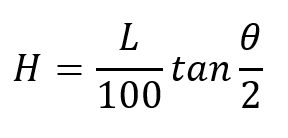
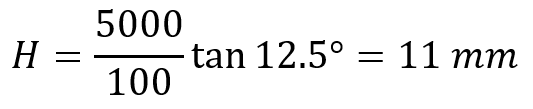
where θ is the LWIR’s horizontal field of view and L is the distance between LWIR and the object being measured. For example, if an LWIR with 25° x 19° lens is positioned 5000 mm from and object, the minimum measurable detail will be
|
Do I need to buy the ImagePro software package?
|
LWIR has a built-in web browser that allows the user to view thermal images and perform simple analyses, such as measuring the peak temperature in a region of interest and output the value on a 4-20 mA interface, or to produce an alarm if the temperature drops below a certain value. These functions are sufficient for many applications. Where greater flexibility and processing power are needed, ImagePro is a powerful, flexible PC-based image processing package which allows the user to perform and display detailed analyses of the data produced by LWIR. |
| Can I install LWIR outdoors? |
LWIR is weatherproof to IP66 and NEMA 4 and is rated for operation between -20 and +60 °C so it can safely be installed outdoors. However its operation can be affected by dirt or water drops on the lens, so it is usually best to install it inside the light industrial housing which provides additional protection, including a purged window and a sunshield. |
| Can I install LWIR in hazardous areas? |
LWIR is weatherproof to IP66 and NEMA 4 so it can safely be installed outdoors. However its operation flameproof housing is specifically designed to accommodate the LWIR imager. It has a gridless widow which gives a clear and unobstructed view, and has approvals for Zones 1 and 21 (flammable gases) as well as Zones 2 and 22 (flammable dusts). |
| What I/O is available? |
The LWIR imager itself has a variety of inputs and outputs.
High-speed Ethernet
- Webserver showing live data and basic image processing
- Modbus TCP/IP for measured and derived data
Configurable analogue signals:
- 4-20 mA output
- Selectable: 4-20 mA output or relay
- Selectable: 4-20 mA input, digital input or relay
A wide range of additional I/O modules can be connected to the ImagePro PC-based image processing software.
|